
The Gestalt
Study created as part of: “Constructing the Gestalt” - Undergraduate Thesis - Virginia Tech (2015-2016)
If the types, or elements, are the most basic unit in which the architectural object can be understood, then the nature in which these elements compose themselves must aim to express the architectural gestalt. Combining these elements results in the creation of a composition that defines a greater sense and awareness of place in the built environment.
“Architecture was predetermined not by types, but by context itself. As an almost inevitable conclusion, architectural theories connected with functionalism deliberately rejected typology…Paradoxically, functionalist theory, which explicitly stood against typology, also provided the basis for a new understanding of the idea of type” - Rafael Moneo “On Typology”
The visual gestalt principle of closure can clearly diagram this concept of parts-to-whole, where the ‘thing’ that completes the whole is implied, given or understood.

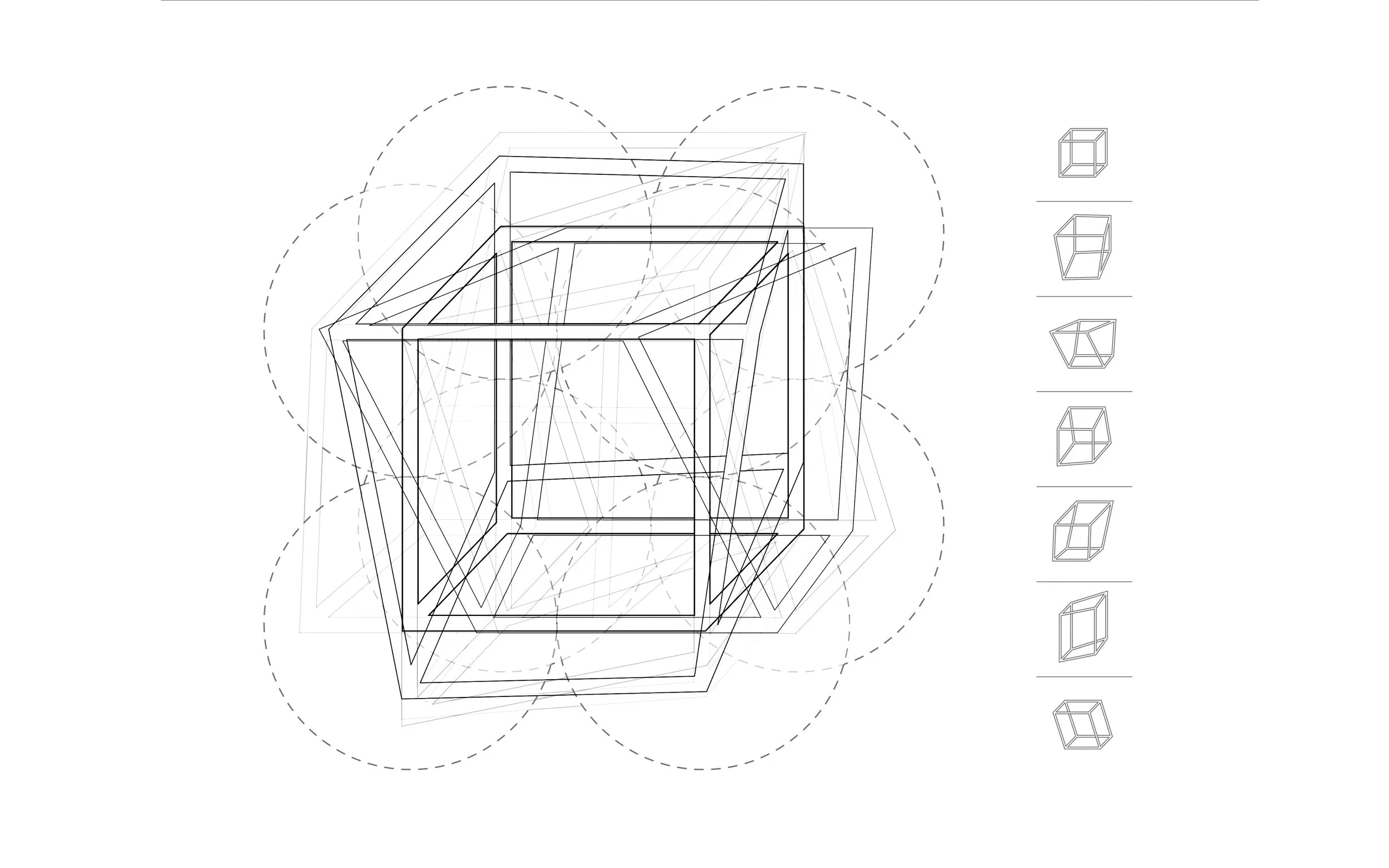
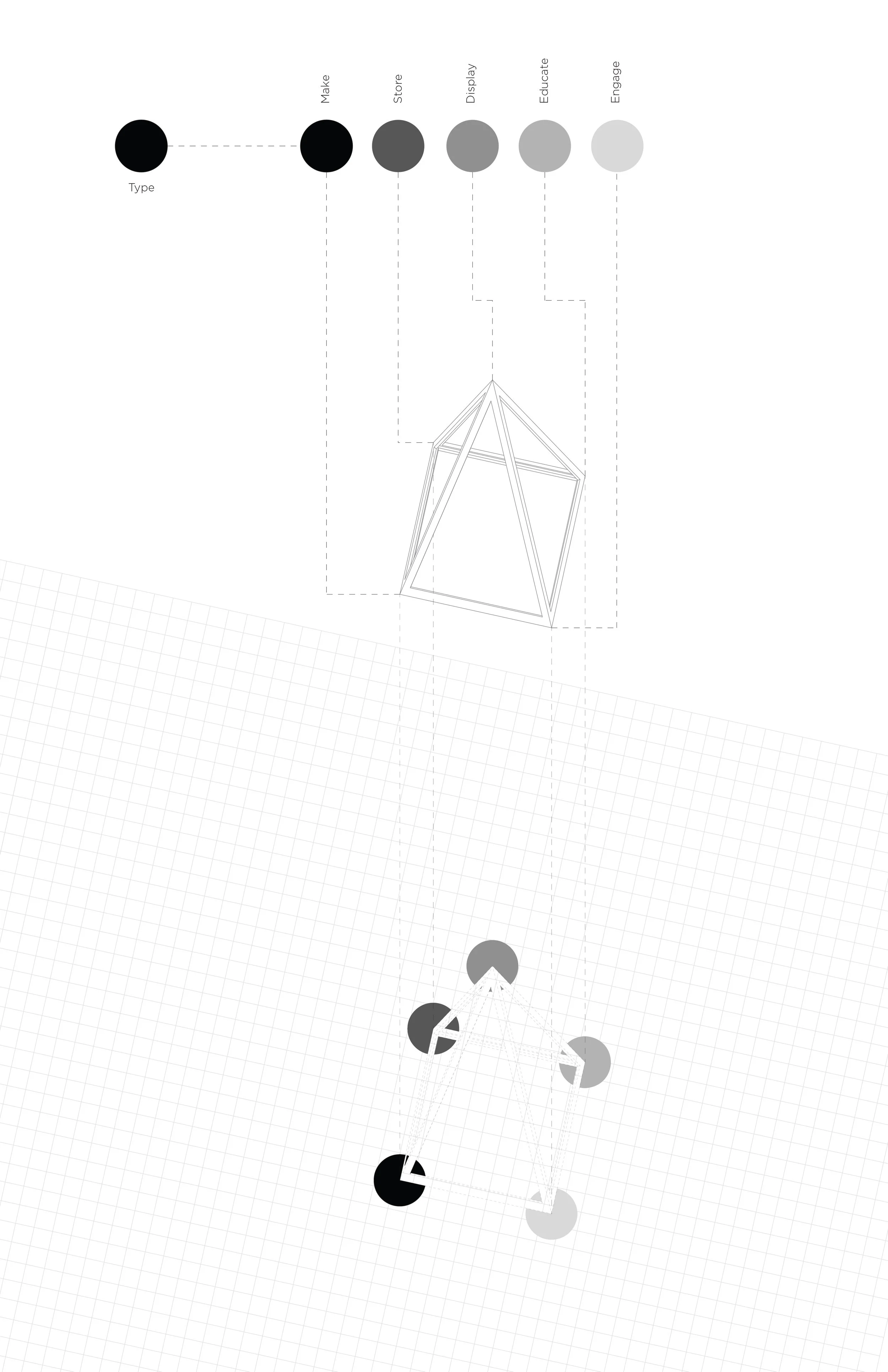
Elements coming together in physical space to create an implied whole.
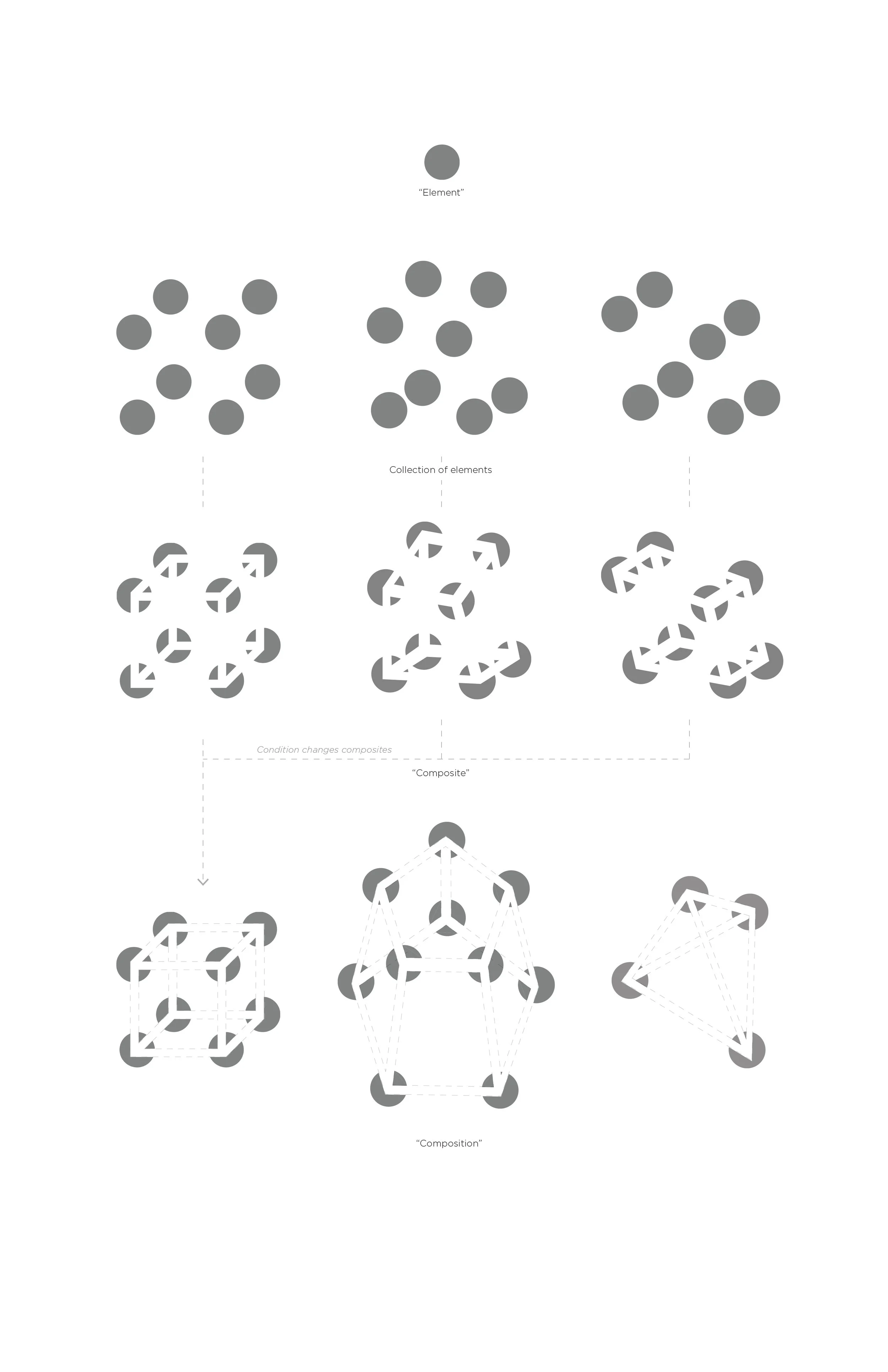
A hierarchy is established through which the elements are composed. The sense of place lives in the composition one makes through cognitive links.
The Means of Construction
Through a series of explorations and architectural investigations a set of ‘means’ were discovered. The means are a series of concepts used as a frame of reference when making design decisions. These concepts were slowly uncovered as initial questions were answered, revised and answered again. Reflecting and understanding the driving forces in the work became a critical moment in the thesis, marking a transition from defining the ‘thesis’ to letting the ‘thesis’ define the work.
-
The physical limitations of gestalt architecture are important in determining the system within which the elements operate. The boundary defines the limitations of a system within a condition. These limitations are key in constructing “a paragon of such composition [that appears] inevitable to all observers.”
The edges of the boundary can be acknowledged in several ways through the physical, the implicit and the built-in. The physical is understood as a form that touches the edge of a boundary. Two forms that partially occupy the edge of a boundary create an implicit occupation of the boundary. Finally, the built-in is latent in the forms of elements growing in a pattern, and from this growth a boundary is defined. The built-in creates the boundary through an inherent condition rather than acknowledging a predetermined condition. The boundary must have a symbiotic relationship with the condition in which the elements are to be placed.
-
“...seeking combinations of void and solid that seem ‘right’, designers produce (hopefully) compelling combinations. A paragon of such composition should appear to be inevitable to all observers. Space is an adhesive in compositional design” -- Fumihiko Maki ‘Investigations in Collective Form’
The gestalt is constructed through a purposeful composition of elements implying something beyond themselves. One method this sense of place is constructed deals directly with the elements’ proximity to one another. In his book ‘Investigations in Collective Form’ Maki presents the space between the parts as the device holding them together, or the ‘linkage’. An implicit order is defined that links the elements together as a result of this meaningful consideration for proximity. The question of proximity plays into architectural gestalts when the scale of the negative space between the parts is changed and the point at which order falls apart is determined.
The necessary conditions in which proximity is a successful adhesive are few but essential. At the core of most proposals for collective forms lies some kind of homogeneity by virtue of mass, color or surface quality. Additionally, the size and scale of the parts requires some restriction if one is to avoid using transitional pieces or creating a uniform background for the parts. Maki acknowledges the limitations of proximity as the sole means through which the implied whole is made, but leaves open the ways through which designers can overcome this limit.
-
“The design process is a way of bringing the elements of a typology - the idea of a formal structure - into the precise state that characterizes the single work” -- Rafael Moneo ‘On Typology’
“We cast a wider net than is designated by the limits of any parameter or program brief in order to establish a larger context from which to proceed empirically, to search for connections of unsuspected significance, and to provoke the emergence of latent opportunities” -- Thom Mayne ‘Combinatory Urbanism’
As the elements unfold within a specific condition degrees of variation are introduced between them. The variability resulting from a response to a condition preserves an order within the elements as well as an order within the physical place the elements create. The qualities that can be varied are many, and it is the task of the study to control what is varied without losing the ‘grain’ or ‘texture’ of the parts. Greg Lynn discusses variability in the context of a continuous/iterative series, where the difference between two parts is the product of three or more variables. This type of series begins to take on an infinite quality, but through iterative reduction can be distilled down to a discrete element.
“We must now see our urban society as a dynamic field of interrelated forces. It is a set of mutually independent variables in a rapidly expanding infinite series” -- Fumihiko Maki ‘Investigations in Collective Form’
The result of this mode of thinking is a collection of constructs that share a vocabulary. Each construct is understood to have a relationship to one another while simultaneously speaking to an implicit or totally ‘ideal’ building. This ‘ideal’ building operating in a Platonic realm can never exist because the vocabulary is imbued with a flexibility allowing for adaptation to a specific condition. Variability becomes an inevitable force in constructing this sense of place.
Why is the nature in which the ‘elements’ are composed critical to the formulation of a new place?
How are the elements defined and how are they composed to effectively address the condition in which they are placed?
What are the limitations of an individual’s perception of the boundary?
How is the boundary experienced or understood? Is there a constructing of the boundary from the language of the individual parts or is one offered a complete view of the whole to experience this boundary completely?
© Forrest Bibeau, 2022